Vault Conference 2026 Takeaways & Recap: Day Two

The team-building session, a case study that called me, Logan Paul, Dan Martell, and the day I stopped calling solopreneurship a strength
Day two was a different animal than day one.
Day one was about knowing yourself, and it moved at a pace where you could sit with things. Day two was about building a team, and it moved fast. Patrick Bet-David said up front they had more speakers this year than last, so some pages in the workbook were going to get skipped. I tried to be diligent with the workbook anyway. I still have a lot of blank spaces. There are questions in there I need to take home and actually sit with, and I’ll get to a few of them in this recap.
This is my day two recap of Vault Conference 2026. The day one recap is here if you missed it, and the final piece in this series will be about what I identified needs to change in my business and what I’m going to do about it.

Why should someone work with you?
Pat opened with a question most of us never ask ourselves directly: why should someone work with you? Not benefits. Everybody offers the 401k match and the vacation policy. He meant something harder. What happens to a person if they associate with you?
There were three questions on the page.
- What benefits are you currently offering to others?
- In what way do people improve by associating with you?
- How many lives have you changed positively in the last year?
I think about the second one often regarding what I put out into the world. I try to lead with a ton of value, probably to a fault. I get excited about an idea and I want to share it, and I’ve been told more than once that I give away too much. I don’t think that’s a bad instinct. I just haven’t been intentional about where it goes.
Then there were three questions people ask when they’re deciding whether to work with you, and these were harder.
What makes your company distinct from the competition? This is the one that’s been an eye-opener the last two days, and not just from the stage. In conversations with people around me, it became obvious that just being me is a liability. Not because I can’t do the work. I can do all of it. But a client looking at a one-man shop has a reasonable fear that he’s taking on too much, that he’s one bad week from dropping a ball, that the quality of service will slide eventually. That’s not paranoia on their part. It’s a valid concern, and I’ve been treating it as a strength.
What separates your leadership from that of others? I don’t have a team right now. I don’t have an answer to this one, and I’m not going to pretend I do.
Do you have a code of honor, and do you embody it? I have a lot of driving principles. They’re real and they’ve been running my business for years. But they’re innate. I’ve never put words to them. And if I can’t communicate them to myself, I can’t replicate them. If and when I hire someone, I can’t hand them a set of principles I’ve never written down. When Pat asked who in the room had written business principles that every employee knows, maybe three percent of the room stood up. I wasn’t one of them.
Larry, Cindy, and John, ten years later
Day one introduced Larry, Cindy, and John: the talented underachiever, the steady achiever, and the less-talented overachiever. Day two put them on a timeline.
At a $3.4 million company, John is the nine and Larry is a four. At $5 million, John slips to an eight, Larry climbs to a six. At $15 million, John’s a five and Larry’s an eight and a half. By $25 million, Larry’s a nine and John’s using guilt: but I’ve been with you ten years.
The point was uncomfortable. The people who got you here are not automatically the people who get you to the next level, and nobody knows in year one which of them is going to keep growing. Only Larry knows he’s going to become an eight. And when John stops growing, he’ll use your loyalty against you, and you’ll let him because you feel guilty. Pat’s word for that was force. Guilt is a force emotion. It’s below courage on the chart from yesterday.
The four roles, and the running mate matrix
Pat laid out four kinds of people every founder needs: running mates, inner circle, advisors, and investors. A running mate is different from an executive. A running mate shares the pressure with you, sometimes more of it than you carry. Pat has Tom Ellsworth. Tom raised the first two rounds for the insurance company, became president, and eventually helped sell it for over a quarter billion.
Then the matrix. Six things to score a running mate on, zero to ten: character, trust, work ethic, vision, competency, and rolodex. Pat scored one of his own people out loud and the rolodex came back a one, even with tens on character and trust. He said the exercise added one question to every interview he’ll ever run: who can you text right now?
I don’t have a running mate in my business. The only running mate I have in my life is my wife. So I ran her through the matrix.
She scored high on almost everything. Character, trust, work ethic, vision. The kind of person that’s hard to find. She doesn’t have the knowledge of my business to just step into a role, and I’m not saying she should. But sitting there scoring her, I realized how much of what I’d need in a partner is already in my house, and how little of it I’ve ever invited into what I do. It confirmed something I’ve known and mostly ignored. That’s a conversation she and I are going to have.
The nine love languages of entrepreneurs
This one was more useful than it sounds. Most people know the five love languages. Pat’s version for the people you work with has nine: we need you, recognition, praise, clear direction, vision, dreams, involvement, challenge, and listening.
Like the original five, nobody has all of them. Most people have two, maybe three. The value was in figuring out which ones drive me, because that tells me where I operate best and what I’ve been missing from working alone.
The one Pat spent the most time on was involvement. He said the single most powerful question a leader can ask is “what do you think?” He told a story about the guy he looked up to early in his career calling him to ask his opinion, and how much that changed his sense of himself. He put it in the hundred-thousand-dollar-idea column. I don’t have a team to ask that question to yet. I do have four kids.
Accountability, principles, and the eight personalities
A lot of the middle of the morning was about managing people, and I’ll be honest that I took a ton of notes on material I can’t use yet.
Accountability had nine points, and the ones that stuck were: don’t accept “they” as an answer, make people name names; give clear expectations with measurable figures; and always finish with love. Pat’s line was that the longer you avoid holding someone accountable, the more you’re training them to believe it doesn’t matter to you.
Then the eight personalities you’ll find in any company: the doubting Tom, the hide-and-seek, the selfish, the victim, the team player, the flag carrier, the pace setter, and the optimist. And the replacement game, which was a list of six things to do to intentionally replace yourself, starting with listing your skills and building a transfer protocol. He said it applies to your kids as much as your company. If you want to build a legacy, you have to decide which skills you’re transferring to them, on purpose.
These are the exact challenges I ran into the last time I had employees. I didn’t have a framework for any of it. So I stopped hiring and started outsourcing to companies that manage their own people, which pushed the management problem onto someone else. That’s worked well enough, and it’s also why I’ve stayed exactly the size I am.
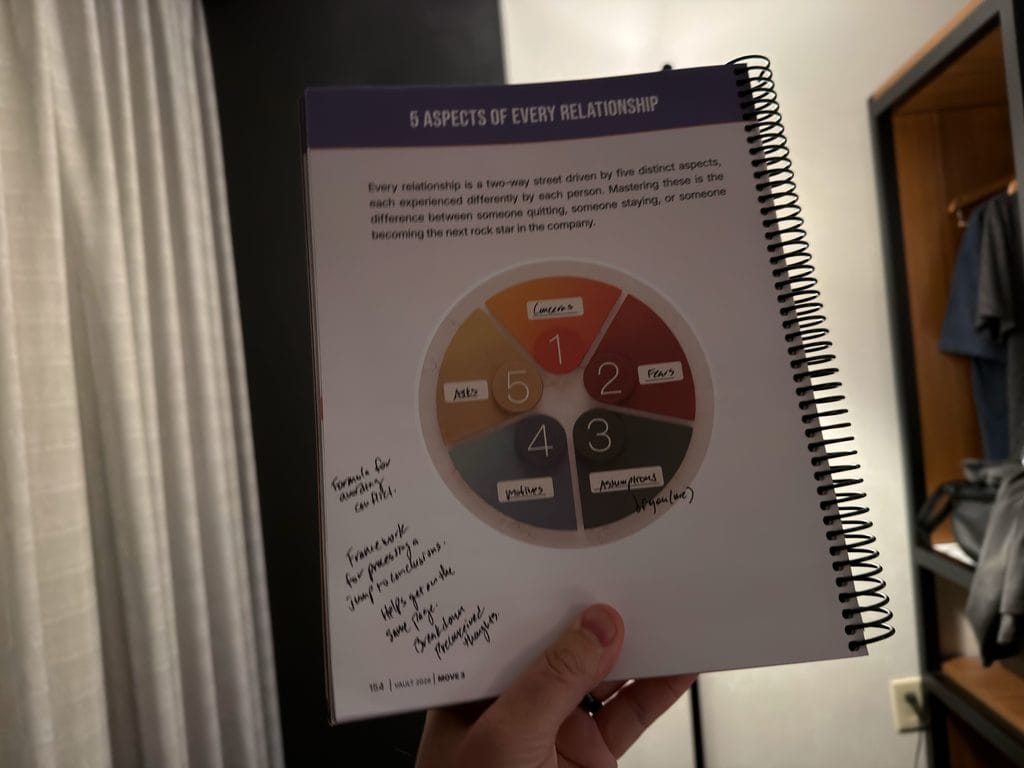
Five things every person in a conflict is thinking
The most practical tool of the morning was small. In any confrontation, each party is carrying five things: their concerns, their fears, their assumptions, their motives, and their asks.
Pat told a story about his oldest son refusing to consider Harvard. Instead of arguing, he opened his laptop and typed out the five things, and asked his son to fill them in. The assumption turned out to be “you just want me to go to college because you didn’t.” The fear on Pat’s side was “you think I don’t have good intentions for you.” Both were wrong, and neither would have surfaced in a normal argument. His son ranked it a top-three conversation of their lives.
He said to write your five down, then write what you think the other person’s five are, and bring both to the conversation. I’m going to use this. Probably at home first.
The case study that called me out
Here’s where day two got personal.
The case study was a guy named Marcus. Took a $40,000 loan, built a $12 million logistics company, and last October his calendar showed seventy-hour weeks, fourteen missed baseball games, three canceled boys’ trips, four date nights all year. His wife gave him until the new year to restructure or she’d file. His eleven-year-old stopped asking him to come to games. He thinks twelve more months of hustle is the answer.
The question was: you’re Marcus, what are your next three to five moves?
In my group, I had to be honest, and what came out surprised me a little. I’ve actively avoided ever becoming Marcus. I don’t miss my kids’ games. I coach them. I’m home for dinner. I take my wife on dates. I put that first and I’ve built my whole business around protecting it.
But I’ve also used it as an excuse not to grow. It’s a good excuse. Nobody argues with “I’m not going to take time from my family.” Except there are creative ways to grow that don’t take time from my family, and I haven’t pursued them because the excuse is easier. So the case study wasn’t really about Marcus for me. It was me realizing I’ve been sitting comfortably on the other side of the same problem.
And the other side has its own version of his trap. I’ve built a machine that requires me. If I took my foot off the gas, some revenue would keep coming for a while, and then it would go to zero. There’s nothing in place that runs without me. Which means if things ever got tight, I’d have to become Marcus just to survive. I’ve been lucky enough not to have to. Luck isn’t a system.
A woman who’d been handed divorce papers in 2022 came to the mic and walked through exactly what she and her husband did to save it. Find your spouse’s love language and block an hour a week for it, non-negotiable. Then in the business, sort your work into four buckets and start delegating from the bottom: the things you’re bad at and hate first, then the things you’re great at but have outgrown. That’s when replacement starts. She said they’ve never been more in love. Somebody else said there’s no such thing as balance for people like us, only integration. I think that’s right.
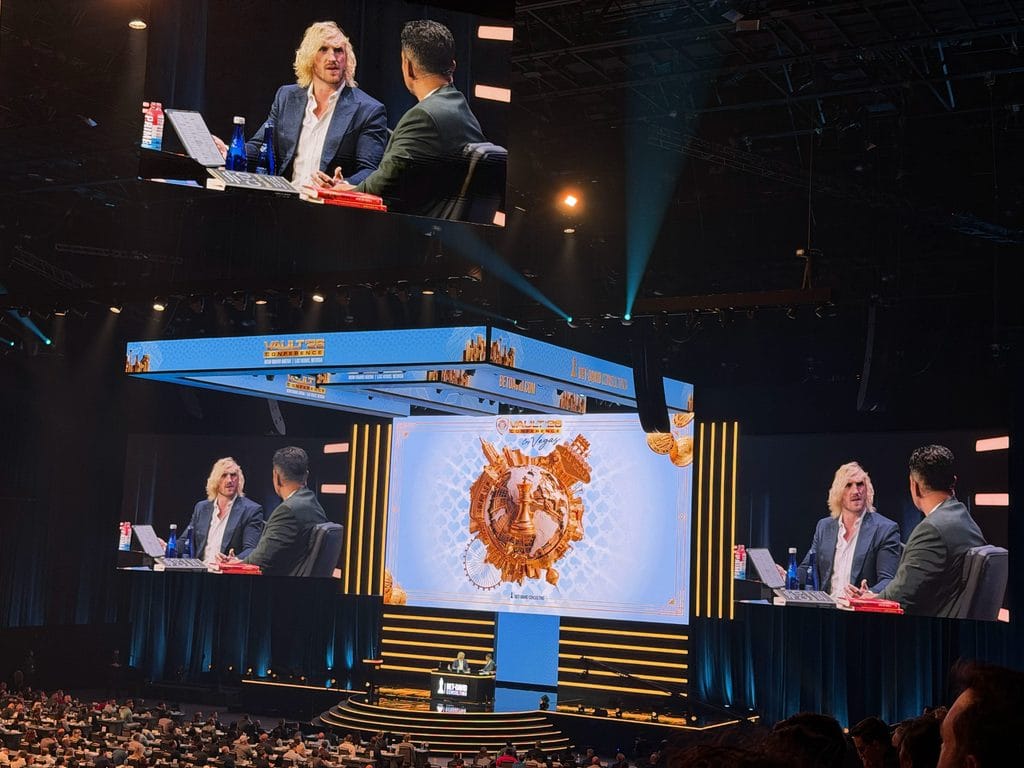
Logan Paul
Most people walk into a Logan Paul interview with a belief system about Logan Paul. He lived up to some of it. There’s a lot of showmanship, and the persona he’s built is doing exactly what it’s designed to do. But there were moments where you could see around it, and what’s behind it is someone more calculated than the persona lets on. He’s taken his lumps, learned, evolved, and found a fit. I don’t want to duplicate anything he does. I can respect a guy who hasn’t given up.
A few things I wrote down.
Sell your kids on what they can become. His dad joked constantly that the boys would get rich and famous and buy him a plot of land to be groundskeeper on. It was a joke. It also happened. Logan said his dad wasn’t a driven entrepreneur himself, he was just trying to make ends meet, but he sold his sons on who they could be. And he worked them. Renovating hoarder houses at ten years old, fourteen-hour days, paid in Wendy’s. Logan’s line: he learned to work hard doing things he hated, so when he found something he loved, he already knew how.
Nurture your child’s natural passions. He was writing novels at seven, inspired by Harry Potter. Begging for a digital camera at eight. His life became the things he loved as a kid. Then he told a story about his aunt scoffing when he said he wanted to run track in the Olympics. That’s not a real job. He said he still remembers crumbling as an eight-year-old. Two of my kids write their own stories. I’ve been more likely to see that as a phase than as a signal. I’m rethinking that.
Consistently good beats occasionally great. Pat’s twelve-year-old asked him for the one quality behind his success and that’s where he landed. I’d rather work with someone who’s consistently good than someone who’s occasionally great. That’s true of employees and it’s true of content.
Authenticity is the highest resonant frequency humans operate at. A kid asked what makes someone stand out among thousands of talented people. That was the answer. Be you.
No exit strategy cost him at least $100 million. Someone asked whether Prime was built with an exit in mind. He said no, called it a massive mistake, and said it cost him a minimum of a hundred million dollars. Don’t be afraid to take chips off the table. It was the most candid thing he said all day.
The afternoon: calibration and Dan Martell
Pat spent the first part of the afternoon on calibration, which is how his companies score every employee every quarter on five things: effort, attitude, leadership, innovation, and results. Each zero to ten, fifty total. He described three kinds of managers who show up in that process. The people pleaser gives everyone high marks and fears conflict. The elitist rates himself high and everyone else low, and drives out the future stars. The steward is fair, and about ten percent of his team doesn’t meet expectations, which is the honest number. If you have more than twenty-five employees, he was clear that you need this. I’ll take his word for it.
He also walked through the five steps the former Tesla president said Elon uses in every company: question every requirement, delete every possible step, simplify, accelerate cycle time, and automate last. The Tesla checkout went from sixty-four steps to thirteen. That “automate last” is worth sitting with in a room full of people who want to automate first.

Then Dan Martell.
I’ve watched a lot of his videos and I’ve read Buy Back Your Time. I haven’t implemented most of it. So I went in knowing the material and came out with something different anyway, mostly because he handed us the exact prompts.
The core of it is a principle: we don’t hire to grow the business, we hire to buy back our time. If you do the second, you get the first. Everyone’s experienced the reverse. Hire to grow, end up babysitting.
The pain line. Every entrepreneur hits it. You won’t grow into pain, so when an opportunity means chaos in your calendar, you do one of three things: stall, sabotage, or sell. Stalling isn’t an option because your best people want a bigger future and someone else will offer it to them. Sabotage is dragging your feet on the email you’re afraid to answer. And selling is usually the grass-is-greener move, and the grass is fake.
The buyback rate. Take what you pay yourself, divide by 2,000 hours, divide by four. That’s your rate. If you can pay someone less than that to do a task, and you’re doing it yourself, you’re working against yourself. He said in a world of AI and offshore hiring, that’s almost everything you do at a computer.
Audit, transfer, fill. Audit your calendar for what’s wasting time and what’s draining energy. Transfer what you know by recording yourself doing a task three times, then handing the recordings to Claude and asking for an SOP. Then fill the time with skills, habits, and beliefs that make you more valuable instead of just more free. He was direct that he is not the four-hour-workweek guy. Buy back time to build an empire, not to sit on a beach.
The replacement ladder. Admin first: someone who owns your inbox and calendar, because your inbox is a public to-do list written by strangers. Then delivery. Then marketing, because most businesses cycle between marketing and delivery and never do both. Then sales. Then leadership, which is Richard Branson having breakfast with his assistant Helen every morning and going skiing.
Four Cs of leverage, from Naval Ravikant: code, content, capital, collaboration. Dan said he had the first three and was bad at the fourth for most of his career.
Transformational leadership. Transactional is: tell them what to do, check that they did it, tell them what’s next. It caps out around twelve to fourteen people. Transformational is: define the outcome, give them a way to measure it, and coach when it misses. And coaching has a shape: state the principle, tell a personal story about how you learned it, and get an agreement on what they’ll do differently next time.
People don’t buy your presence. They buy your standards. Price things as if someone else is doing the work, not as if you are. The methodology is the product.
The thing that was funny to me is that none of the prompts were rocket science. I could have written most of them. I’ve run versions of them, trying to get AI to triage my email. I just never honed any of it to the point where it worked, and the reason is uncomfortable. I waste a real amount of my day sorting an inbox by hand, deciding what’s an opportunity and what’s spam and what to ignore. I know the tool on the other side of that work would give me that time back. I haven’t done the work.
There’s a bigger version of that problem. Dan says to audit your calendar. My calendar wouldn’t tell you much, because most of what I do isn’t on it. I context-switch and jump around all day. The tools he’s describing can’t give me feedback on time I never captured. So before any of this works, I need to actually put the information in place for it to work from. That’s not an AI problem. That’s a me problem.
And the biggest one. I’ve been doing a better job lately of recording and capturing what I do, mainly because I want to make some of it available to other people. But I need to be systematizing it for a different reason. If I keep being a solopreneur, I’m building something that will always require me, that I can never step away from, and that has no value to anyone else. The only way someone could buy it is if they wanted to do everything I do, exactly the way I do it. That’s not buying a business. That’s buying a job.
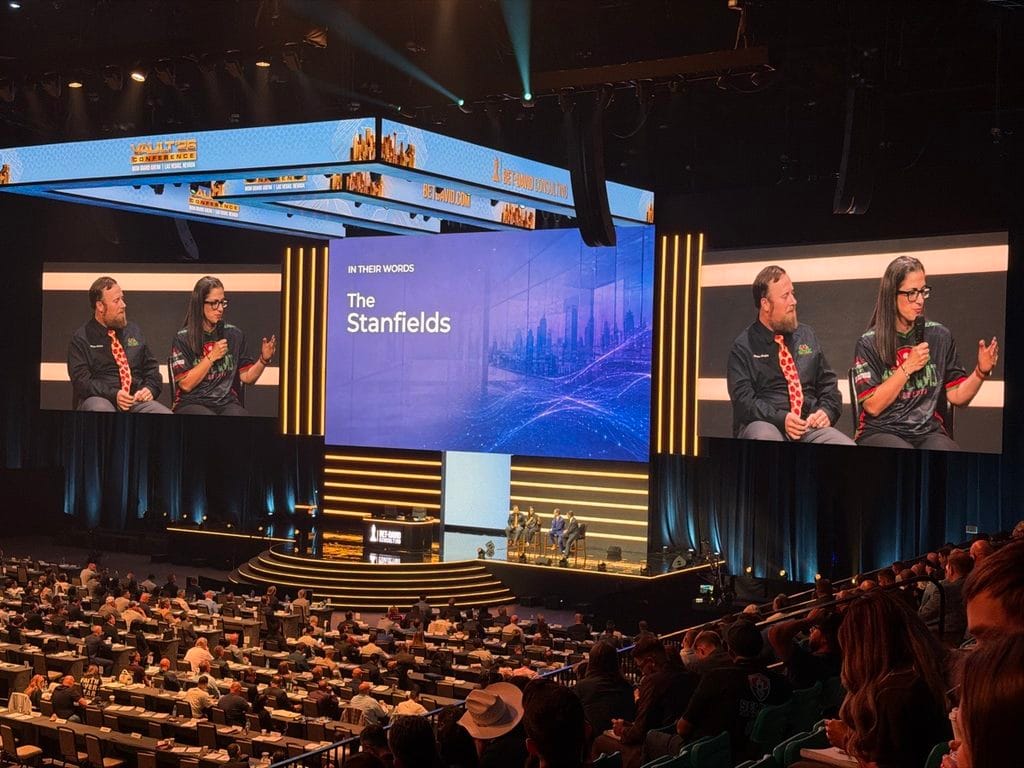
Hire Metrics
The rest of the afternoon was Tom Ellsworth and Paul Williams walking through their software, Interview Now and Performance AI, with clients on stage. A pizza chain with eight locations that gets 150 applicants a week and replaced a full-time recruiter. A construction company with mostly field labor that’s calibrating superintendents and up. It looks genuinely good. If I had the problems it solves, I’d be using it. I don’t. It’s not a tool a solopreneur needs, and it’s probably not a tool someone with five or ten employees needs either. It’s for twenty and up.
What I took from it was different. Listening to the clients describe their hiring and retention problems, I recognized several from the last time I had employees, back when I didn’t know anything about any of this. Now I know more, and I know the tools exist. I’d like to have those problems someday. That’s a strange thing to write, and I mean it.
The offer, and next year
The day closed with the dates and pricing for Vault 2027, back at the same arena, August 30 through September 1. I’ll be honest: I want to bring as many people as I can. I want to bring my wife. I want to bring my kids. Not for every session, but there are specific parts of this that they’d find genuinely interesting, and the family-business panel from day one made a good case for why they should be in the room.
My goal is to come back next year with more people and with more of the problems business owners actually have. Because I’ve grown. I still enjoy parts of solopreneurship and I’m not going to pretend otherwise. But I need to graduate from it into something that produces value at a scale I can’t reach by myself.
The final day opens with a session on building a business while being a good father and husband. That’s the one I came for.