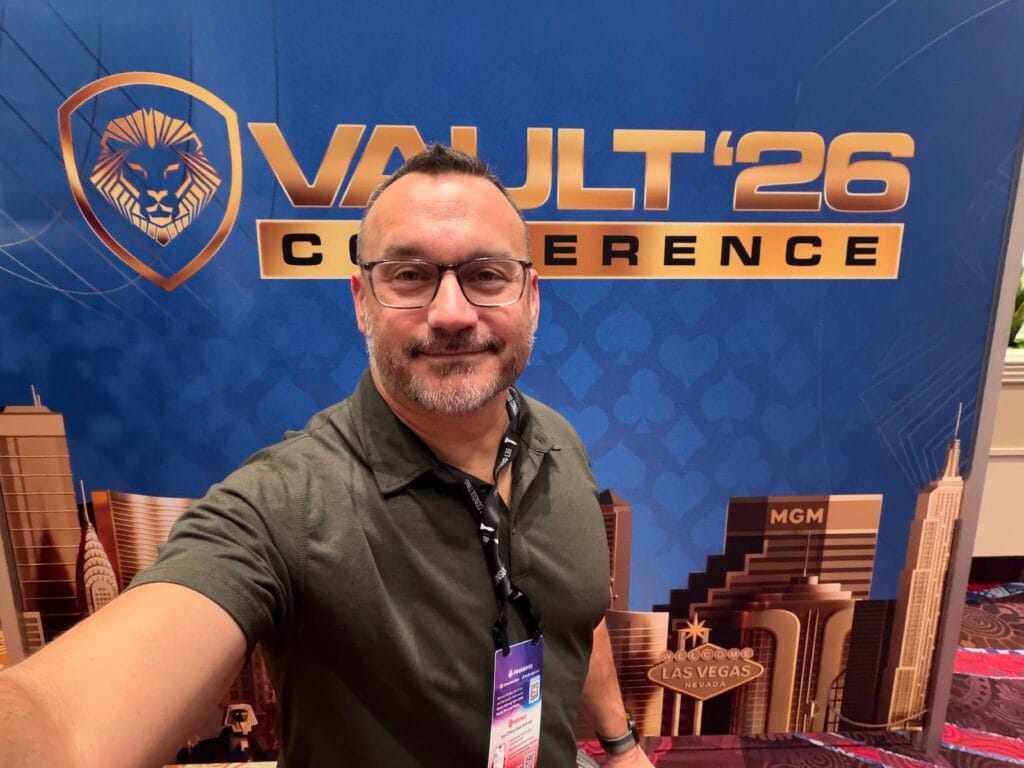
Vault Conference 2026 Takeaways & Recap: Day One

Seven mountains, a 23-year-old who exposed billion-dollar fraud, Steven Bartlett’s playbook, Floyd Mayweather, and the thing I realized about my own family business
I signed up for Vault Conference on an impulse after watching a webinar. Then, in the weeks before it started, some of the content I consumed had me second-guessing the decision. I figured there was a real chance this would be a lot of hype for Bet-David Consulting and not much depth for someone like me.
I was wrong. Day one was one of the most useful days of business content I’ve sat through in a long time, and I’ve been self-employed for 27 years. This is my recap of day one at Vault 2026. I’ll write a separate recap for day two, and then a final piece about what I identified that needs to change in my own business and what I plan to do about it.

Morning session: the seven mountains
Patrick Bet-David opened with a framework he first heard from his pastor, Dudley Rutherford, back in 2009: there are seven mountains you can climb to have influence in the world. Arts and entertainment. Business. Education. Family. Government. Religion. Media.
The exercise was simple. Pick the one or two mountains that actually excite you. Not the ones that pay best, the ones you’d use your success to impact if you had it.
The part that stuck with me was how he told us to find yours. Look at what you love, what bothers you, and what you hate. Strong emotion points at calling more reliably than logic does. He referenced a book by a British diplomat that argued people end up pursuing the cause they love, the thing that bothers them, or the thing they hate, and that usually traces back to something that happened to them as a child. For Pat, growing up in Iran where you couldn’t say what you believed, it became capitalism and media. Nobody gets to tell him to be quiet.
Media was on my list. It’s also the one that would require restructuring most of what I currently do. I have two YouTube channels over 100,000 subscribers, and for most people that’s a starting line. For me it feels more like a finish line for those specific channels. I’ve outgrown their topics. More on that in the final article.

Nick Shirley: climbing the media mountain with conviction
Pat brought up Nick Shirley as a case study for the media mountain, and it was the right choice. Nick is 23, an independent journalist, and the person behind the Minnesota daycare fraud video that hit 140 million views, got retweeted by the Vice President and Elon Musk, and led to federal raids. California’s legislature responded with AB 2624, which people now call the Stop Nick Shirley Act. He’s had death threats and had to move his family out of their house.
Two things from his interview are worth remembering.
First, the number nobody wants to hear. He’d made at least a thousand videos before the one that changed everything. He posted every week from age 15 to 18 and only got to 20,000 subscribers. Then he picked a niche and went from 20,000 to nearly two million. His advice was blunt: post ten videos, find the one that works, and make that exact video again with a small variation. Double down until it stops working.
Second, the reason his stuff reaches everyone. He said he makes his videos so a five-year-old and a 95-year-old can both understand them. He’s not trying to make it left or right. He goes to the location, shows what’s actually there, and keeps it simple. When a 70-year-old and a 12-year-old both come up to you at a casino, you’ve done that right.
And on the fear, he was clear that it doesn’t stop him because he believes the public deserves to know where their money goes. That’s what conviction looks like when it costs something.
The personal identity audit
Move one in the workbook is mastering the art of knowing yourself, and Pat and Tom Ellsworth tag-teamed it. A few concepts I’ll be carrying home.
Three kinds of achievers. Larry, Cindy, and John. Larry is the most talented kid in your high school, the one everyone expected to win. Cindy has less talent and achieves exactly what’s expected. John has the least talent and overachieves because he never quits. Then Pat asked everyone to shout the name of the most talented person from their high school and the most successful person from their high school, and they were almost never the same name. Potential is not the variable. Drive is.
Future truth. Pat has video of himself in 2011, before he had a YouTube channel, saying that one day he’d interview presidents and have Kobe Bryant on his show. His own guys thought he was trying to be a motivational speaker. His point was that a future truth is only true to you. To everyone else it’s a lie until you make it real. That’s the job.
The flywheel. He showed Disney’s 1957 flywheel, a hand-drawn map of how theatrical films, TV, music, merchandise, comics, and Disneyland all fed each other. Then a version ten years later, then Disney today. We had a minute to draw our own. My honest note to the guys next to me: I’ve got pieces of flywheel everywhere, and none of them are on the same engine. That one sentence might be the most important thing I wrote all day. I’ve known it for a while. Seeing it drawn made it impossible to keep ignoring.
Pain threshold. Tom’s framing was that the pressure of being the founder is supposed to feel this way. You’re carrying the vision, the payroll, and the risk. Accept the threshold, and then build a peer group so you’re not carrying it alone. He said don’t leave the conference without five new people in your phone you can text on your worst week. The Thanksgiving table is often the loneliest place for an entrepreneur, because nobody there understands what you’re holding.
What happened at the tables
A lot of the value on day one came from the exercises where you turn to the people around you and process out loud. The moment you have to say your mountain to a stranger, it becomes real.
I sat with a couple in the longevity and wellness space who had real leadership development insight, and we ended up trading. Their biggest struggle is online awareness. Google changes something, their organic presence drops, and they fight to get it back. We spent time on Google reviews, which are now one of the primary feeders for AI overviews. A lot of what shows up in an AI summary of a business is pulled from what customers wrote, not what the business wrote. I walked them through the three-email review sequence I run for clients, where the first two emails are simple reminders and the third introduces a little concern that we may have done something wrong. That third one closes most of them.
I also met a couple of young founders from Silicon Valley building software for industrial technicians. Everyone was dealing with some version of the same thing: more opportunity than time.
Afternoon: processing issues and making better decisions
The afternoon opened on decision-making. Pat’s framing is that the most important skill in life is processing: making the best decision available with the information you have and the odds in your favor. We wrote out our last five big decisions and scored them, then he made us write down one that failed, because everyone had only written the wins.
Tom’s contribution was ITR, investment time return. Before you bring a leader a crisis, quantify it. What’s the return, meaning the impact if you don’t fix it? How much time will it take? What does it cost? When people get in the habit of running ITR, half the crises never reach the boss because they realize they were small.
The root cause exercise was the most useful part. Take the decision that failed and ask why five times until you hit the actual cause. One attendee, an affordable housing developer, said by the fourth why it stopped being about the market and became a character flaw. That matched my experience. Persistent problems are usually the ones I framed wrong because I was too sure I’d figure it out.
I’ll be honest that I struggled with the case study on the 50/50 partnership gone sideways. It’s a great framework. I just don’t have partners or a team, so I’m still working out how to apply it to a business that is mostly me. I suspect the answer is that I’m both partners in that case study, and that’s its own problem.

Steven Bartlett
Then Steven Bartlett came out, and the room changed. He flew in from the UK, and he held nothing back. If you only read one section of this recap, read this one.
Think in principles, not tactics. His argument is that the correct answer to anything in business is now changing faster than a book can be published. So instead of collecting tactics, he collects principles that hold regardless of what the world is doing. Everything below is one of those.
Increase your rate of experimentation. His company has a head of failure and a team whose only job is to increase how often the organization tries things. He incentivizes the rate of trying, never the outcome, because if you reward outcomes people get scared of being wrong. He pointed at Bezos’s shareholder letters and Booking.com’s decision to build an experimentation platform to kill the guesswork.
The one percent. He read The Slight Edge at 18 and it shaped everything. Things that are easy to do are also easy not to do, and every part of your life is compounding for or against you based on how seriously you take the small stuff. His team obsesses over details competitors ignore: the scent in the studio, the CO2 level in the room, the music playing when a guest walks in. He said a ten-second change to the show increased their growth rate by 180 percent. When a team stacks tiny wins, they feel like they’re going somewhere, and that’s the motivation, not the big swing.
Push on paper walls. Most constraints are preference and tradition dressed up as physics. Zara building factories in Spain when everyone said it was too expensive. Roger Bannister breaking the four-minute mile and eleven people doing it within days. Wheels on suitcases, which department stores refused to sell because men wouldn’t be seen pulling one. His own animator said a video took nine days until Steven asked what it would take to do it in two. The answer was a new laptop. Four years of nine-day turnarounds because nobody asked why.
Long-termism. Time horizons determine behavior. Give someone sixty seconds and unlimited bricks and they stack vertically. Give them a year and they build a foundation. He’s thinking in 50-year horizons, which is why he owns the hosting platform his shows run on instead of renting distribution.
Sovereignty. This is the one I needed to hear. Platforms are now running everything you post through an AI to match it to whoever will keep scrolling, which means your follower count matters less every year. Social media used to be the bottom of the funnel. It has to become the top, with the owned relationship at the bottom. His metric isn’t followers. It’s how many email addresses and credit card details he has. He’s even experimenting with physical mail to his audience, because you’ll always need somewhere for packages to arrive.
Irreplaceably human. With AI about to flood every platform with infinite content, he’s doubling down on two things: sovereignty, and content that a human had to live to make. His line was that if there isn’t a layer of lived experience in your newsletter or your podcast, you should assume its value is going to decay. Information is a commodity now. What people will still want from a human is the relatable, lived layer that AI can’t produce. He said he thinks the human documentaries his team is producing will end up bigger than his podcast.
Listen. Great interviewers follow, they don’t lead. He’s never written a question down. He shared a framework a former CIA officer taught him for what motivates people, RICE: reward, ideology, coercion, ego. Ideology is the strongest, ego is second, and money is further down the list than most of us assume. He uses it in hiring, in sales, and in every interview.
One more thing he said that I wrote down twice: money is a lagging indicator of value, and if nobody is skeptical of your idea, you might be late.
He closed on kids and AI, and I’ll paraphrase because it landed on me as a father. People who do hard things grow the part of the brain that handles hard things. If you defer your thinking to AI, that atrophies. Knowing the right question to ask is going to be the most valuable skill of the next decade, and it only comes from deep understanding of the problem yourself. He said he writes more memos now than at any point in his life for exactly that reason. This is the same tension I’ve been writing about for months, and hearing it from someone running a media company at his scale was validating.
Evening: family and business
The evening opened with a panel of three family businesses that work with Bet-David Consulting: a McDonald’s operator with 22 locations, a construction company run by brothers from Siberia, and a father-and-son appliance repair business that went from under a million to $22 million in four years.
The consistent theme was that none of them separate business and family. They blend it. They bring their kids and their spouses to the conference. One of them has a list of 75 books every one of his kids reads by 18, and every leader in his restaurants reads them too. He gifted his kids equity years ago, when the company was worth less and carried more debt, so they’d feel ownership early. His line was that if you get to choose your future partners, you should raise them.
This was the session that hit me hardest, and not because of the tactics.
I want to raise entrepreneurs. I’ve said that for years. But I’ve struggled to actually invite my kids into what I do, and sitting there I understood why. I’m often making it up as I go. Not because I don’t know what I’m doing, but because I’m not running a process that can be taught or replicated. My kids get small windows into my work, and when they can see what’s actually happening, they get it. I want more of those windows, and that means the process has to exist somewhere other than my head.
The same is true for my wife. She and I come from different worlds, and I’ve allowed that difference to justify keeping the business over here and our life over there. I don’t want that anymore. She has insight, and more importantly intuition, that I’ve never tapped in the business. There’s value she could bring that I haven’t explored. What I want is family ownership, not me carrying all of it and feeling alone while I do.
That’s going in the final article. It’s the thing I actually need to change.
Power versus force
Pat walked us through David Hawkins’s levels of consciousness, the force side on the bottom and the power side on top. Shame, guilt, apathy, fear, desire, anger, and pride are force. You’re trying to make things happen from a weak position. Courage is the first level of power, and it’s the pivot. Then neutrality, willingness, acceptance, reason, love, joy, and peace.
His practical use of it is simple. When someone on his team is stuck in fear, he shows them the chart, shows them where they are, and asks them to get to courage. Nothing above that is available until you do. He uses it with his kids and his sales team. The book is slow for three chapters, he said. Push through to the fourth.
Floyd Mayweather
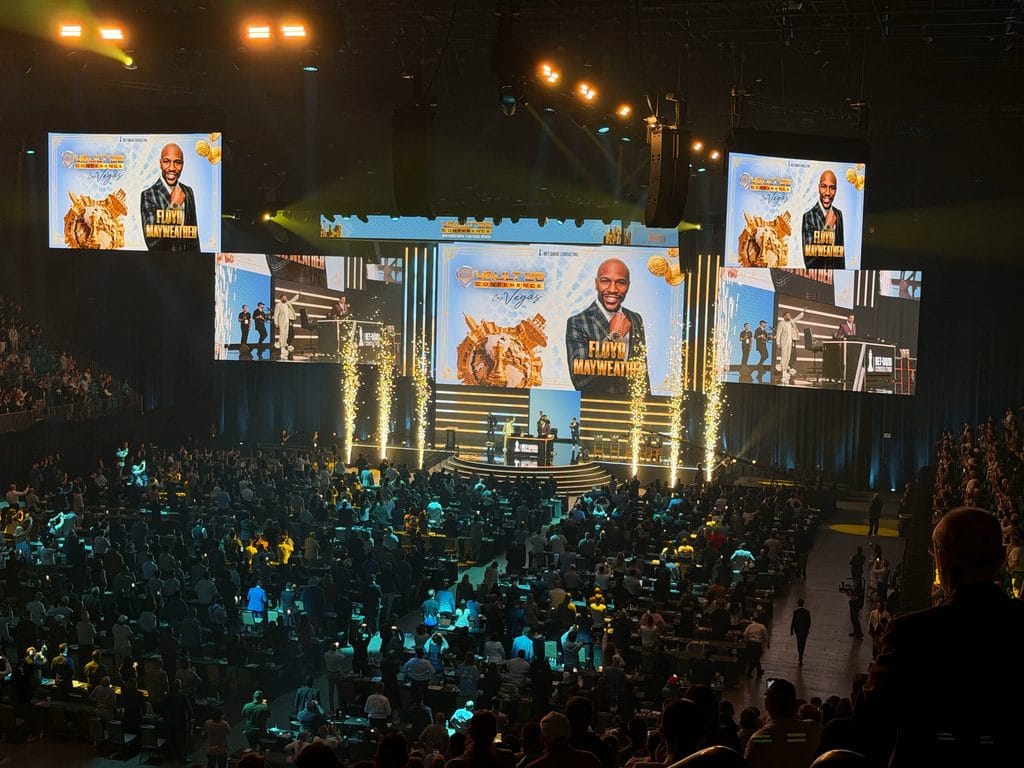
The surprise guest was Floyd Mayweather, at the arena where he went 15 and 0. A few things stuck.
At one point he asked what it would take to become his own promoter, and the answer was $750,000. He wrote the check. In the three fights that followed, McGregor, Pacquiao, and Canelo, he made roughly $750 million. When Pat asked whether he’d have accepted that check if a fighter offered it to him, Floyd said he’d let them go. He doesn’t want to hold anyone hostage, because he knows how to climb.
His business lesson was learned the hard way: trust but verify. Two people he thought were friends stole a combined $550 million from him, and he’s still in litigation. He said it without bitterness. His life is still great, his family is healthy, and he’s going to keep climbing.
On the mental side of boxing, his approach was to identify an opponent’s greatest strength and take it away, forcing them to fight in a way they didn’t want to. That’s a useful lens for competition in general.
His advice to a young man in the audience was three words: invest in yourself first.
The conversation I didn’t expect
Walking out of the afternoon session, three guys were holding up a phone that said something like “Looking for marketing.” My first instinct was that I was about to get pitched a lead-gen service for agencies. I get those emails several times a day.
They weren’t selling anything. They each own a house cleaning business, and they’re building a directory site to help people find cleaning providers in their area, because they’re tired of the expensive lead-gen platforms most cleaners are forced into. Their question to me was how to acquire customers with ads.
I told them that would recreate the exact problem they were trying to escape. We spent about twenty minutes on the alternative: user-generated content as the exposure engine, and verification specific to their industry that builds trust and eliminates the fear consumers have when hiring someone to come into their home. The big platforms can’t do that because they’re industry-agnostic. They can.
Conversations like that fire me up more than any session. Finding a route to growth that doesn’t require competing head-on is the whole game, and it’s what Blue Ocean Strategy is about. The book argues that lasting success comes from creating uncontested market space instead of fighting in crowded water, but the same thinking applies to how you market. The question worth asking about your own business is what blue ocean marketing looks like when everyone else in your category is bleeding in the red one.
What I’m taking into day two
One flywheel, not five. Courage as the first move. A process my family can actually see and step into. And Bartlett’s word: sovereignty. Own the relationship, don’t rent it.
Day two recap is next. If you’re at Vault and reading this, come find me.