Seventy People in My Yard
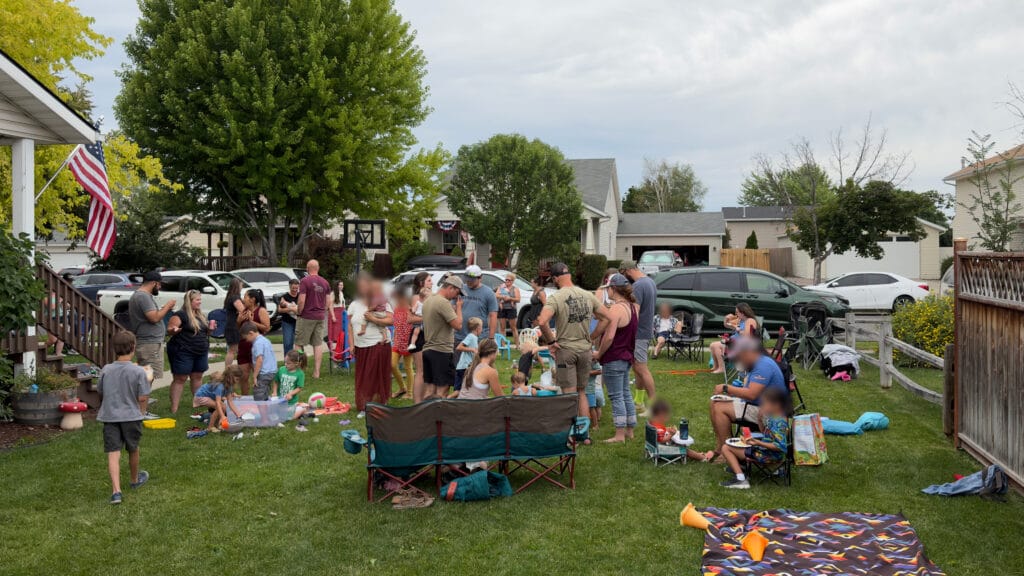
Last night my wife and I hosted a barbecue in our yard. Calling it an event is generous; it was a get-together. We invited the families from the Moms With Littles group my wife started at our church several years ago. It’s a group for young moms with toddlers and new babies, built around a simple idea: don’t be stuck at home alone with little kids. It’s been hugely successful, but it’s always been just the moms. We wanted a way to get the whole families together so the dads would come and meet people too.
Just shy of 70 people showed up. Our yard is not large. We barbecued hot dogs, put out a couple of water tables and some yard games, and let the kids play. There was zero agenda other than getting to know each other.
Here’s what stuck with me. Over and over I heard some version of the same thing: “I’ve seen you from a distance many times but never met you.” Or, “We’ve met, but I’ve never actually gotten to know you.” These are people who have been attending the same church, sometimes for a year or longer.
After everyone left, my wife’s phone buzzed for hours. Women texting about the person they finally talked to, the number they forgot to get, the plans they were making, the husbands who do similar work. Dozens of connections that happened in one evening in a backyard, connections that never happened across a long span of Sunday mornings.
The transactional Sunday
One of the biggest problems my wife and I have with church, and it’s not just our church; it’s most churches, is that once a church gets past 200 or 300 people and multiple services, it becomes nearly impossible to connect with anyone. Every step of a Sunday morning, from the parking lot to the drive home, is transactional:
- Here’s a bulletin at the door.
- Everybody comes inside.
- Everybody says hi during the sixty seconds allotted for it.
- Everybody sits down and listens.
- Everybody gets up and leaves.
You may see the same person week after week, but it never goes beyond that, because nothing in the structure makes it comfortable to go beyond that. I don’t believe this is intentional. It’s just what Sunday morning has become. But the result is the same: a format that is not conducive to building relationships.
Meanwhile, the language we use keeps promising something else. Corporate worship. Coming together. Doing life together. I hear these phrases constantly, but they’re not anybody’s reality. People are doing life with whoever they’re actually around: coworkers, neighbors, the families their kids play sports with. Not the people they sit near for an hour a week.
Why so many people feel lonely
This is why so many people feel lonely at church, and honestly, why so many people feel lonely on social media too, despite constantly being told they’re part of a community. They’re not part of a community. They’re an audience member. A viewer. A consumer in a transactional experience.
To understand what community is, it helps to name what it is not.
Community is not an event. You can throw an enjoyable event where nobody actually connects with each other, and what you’ve built is a commercialized community at best. If you’re leading a church or hosting an event and you’re not connecting people to each other, or worse, people walk in and feel judged, you’ve created a jury, not a community, even if you never meant to. If the host isn’t walking around introducing guests to other guests, it’s not community. A one-off event that happens once a year isn’t it either. A run club does a better job of building community than most events do.
A real community has at least these five markers:
- It’s recurring. You keep seeing the same people over and over again.
- People actually know each other. Not “I’ve seen your face”; you know each other’s names and details about each other’s lives.
- There’s mutual respect and a common goal.
- People take care of each other. It’s reciprocal. You help them, they help you. It’s not one-sided and it’s not transactional.
- You feel like you belong. You’re not a visitor at an event. You walk in, and you feel seen.
Notice what’s not on that list: liking the same stuff. Having things in common just means you have things in common. That extends to church too. Just because everyone in the room loves Jesus doesn’t mean there’s community in the room.
If you’ve been showing up to something hoping for community and walking away empty, this is probably why. You’ve been taking part in a transaction.
It’s easier than we think
Here’s the part that surprised me most about last night: how easy it was. Open up your yard. Invite people and their kids. Put out some water tables. Grill some hot dogs. Then get out of the way and let this natural thing called community happen.
Somewhere along the line we convinced ourselves that everything needs to be organized, everything needs to be an event, everything needs to be planned and maximized. That’s just not the case. The most meaningful connections I watched happen last night required nothing more than an unstructured evening and an open yard.
The church doesn’t have a worship problem or a teaching problem. It has a connection problem. And the fix might not be another program. It might be seventy people in somebody’s yard.