
What 2025 taught me about being busy without being purposeful
I’ve been creating content online for over two decades. YouTube videos, online courses, client work, photography, writing. I’ve built multiple income streams, grown audiences, and helped thousands of people learn new skills.
And for most of that time, I’ve had no strategy.
I’m not exaggerating. I would create videos when inspiration struck. I’d launch courses when I had time. I’d say yes to client projects that came my way. Some months were great — a video would take off, affiliate sales would spike, students would enroll in courses. Other months felt like shouting into the void.
I told myself I was being flexible. Responsive to opportunities. Following my creativity.
The truth? I was scattered. And 2025 made that painfully clear.
The Wake-Up Call
Early in 2025, I lost my largest client. They represented 45% of revenue from one of my businesses. The separation was mutual — I had been making recommendations rooted in hard data that they couldn’t figure out how to implement. Rather than prolong the inevitable, we parted ways.
Here’s what surprised me: I wasn’t devastated.
For years, I had been building multiple income streams precisely because I knew something like this could happen. I had diversified. I wasn’t living at 100% of what we were bringing in. When the hit came, we weren’t struggling. Aside from car payments, we have no debt.
But here’s what did bother me: I didn’t replace that income as quickly as I wanted to.
I had all these channels — YouTube, courses, client work, a new business idea I’d been sitting on for a decade. But I had no coordinated plan for how they worked together. I was busy, but I wasn’t strategic.
By the end of 2025, my course revenue was one of the lowest years I’d had in a while. My running goal of 500 miles fell short at 261. I had launched Site Nitro, my WordPress management service, but gained zero new customers in December because I let other things crowd it out.
I had been productive. I had not been purposeful.

The Shift: Stewarding What I Already Have
As I approached 2026, I realized something important: I don’t need new ideas. I need to steward the ideas I already have.
This is hard for me. I’m someone who sees problems and solutions everywhere. I get energy from dreaming about new possibilities. The rush of a new idea feels like progress — until I realize I’ve abandoned the last three ideas that felt just as exciting.
I’ve come to understand that I get a dopamine hit from dreaming. The crash comes when I have to actually execute. So I chase the next dream instead of doing the hard work on the current one.
2026 needs to be different. Not because I need to do more, but because I need to do what I’m already doing with focus and intention.
I sat down and looked at what was actually working:
My camera-specific courses sell the best. Not productivity courses. Not general photography courses. Courses tied to specific camera models that people are searching for.
My tech and camera YouTube channels drive students to those courses. I had never built a strategy around this. I was afraid my videos would come across as sales pitches, so I barely mentioned my courses at all.
Site Nitro has the highest revenue potential of anything I’m building. At 50 customers with my current pricing tiers, it could generate $7,500/month in recurring revenue. That’s more than my entire course revenue from 2025 — every single month.
I’ve enjoyed writing this past year. My written content has been driving massive traffic increases — 678% to my photography site, 530% to my agency site. I published 65 Substack posts in 2025. My top-performing post wasn’t about business or productivity. It was a letter to my son.
The pieces were all there. I just needed to connect them.
God First, Then Goals
Before I go further, I need to be clear about something: my goals don’t come first.
For too long, I’ve operated with a pattern I’m not proud of. I do my own thing, make my plans, execute on my ideas — and then pray about it later. I ask God to bless what I’ve already decided to do rather than seeking Him first.
2026 is the year that changes.
I want to better understand what it looks like to seek Christ first and have the most productive year of my life. Not productivity instead of faith. Productivity that flows from faith. God doesn’t get my leftovers — He gets my time and focus first, and then I work and pursue my goals.
This is why my daily rhythm starts with Scripture before work. Not because it’s a box to check, but because I’ve learned that when I skip this, I spend my day reactive instead of intentional. I chase urgency instead of importance. I make decisions from anxiety instead of peace.
My goal for 2026 is 300+ days of Scripture before work. Not perfection — I’ll miss days when I’m sick or traveling. But the default is clear: God first, then goals.
The Goal-Setting Process
I didn’t pull my 2026 goals out of thin air. I looked at what I had been doing, what was working, and what needed more focused attention.
Here’s the framework I used:
Start with data. What actually produced results in 2025? What did I spend time on that went nowhere? My camera courses sold best. My written content drove traffic. Site Nitro has the math to become my largest income stream. These aren’t guesses — they’re patterns.
Filter through values. Some things aren’t negotiable. Family. Fitness. Faith. These aren’t goals that compete with work goals — they’re the foundation that makes work goals possible. If I’m not healthy, present with my family, and grounded spiritually, no amount of business success matters.
Identify what’s already working. I don’t need to invent new revenue streams. I need to be strategic about the ones I have. The tech and camera channels already drive course sales — I’ve just never built that into a plan. Site Nitro is already serving a handful of clients — I just haven’t prioritized growth.
Set specific numbers tied to specific actions. “Grow my business” isn’t a goal. “50 Site Nitro customers by December 31” is a goal. “Create 2 camera courses for the models I already have in hand” is a goal. Specificity creates accountability.
Build in decision points. I don’t have clarity on everything. Schedule Sovereignty — the concept of helping Christian men take control of their time to serve their highest priorities — keeps surfacing in my writing. But I’m not ready to commit to building a course or product around it. So I’ve set a Q2 decision point. By June, I’ll evaluate what’s resonating and decide whether to formalize it or let it remain a theme in my writing.
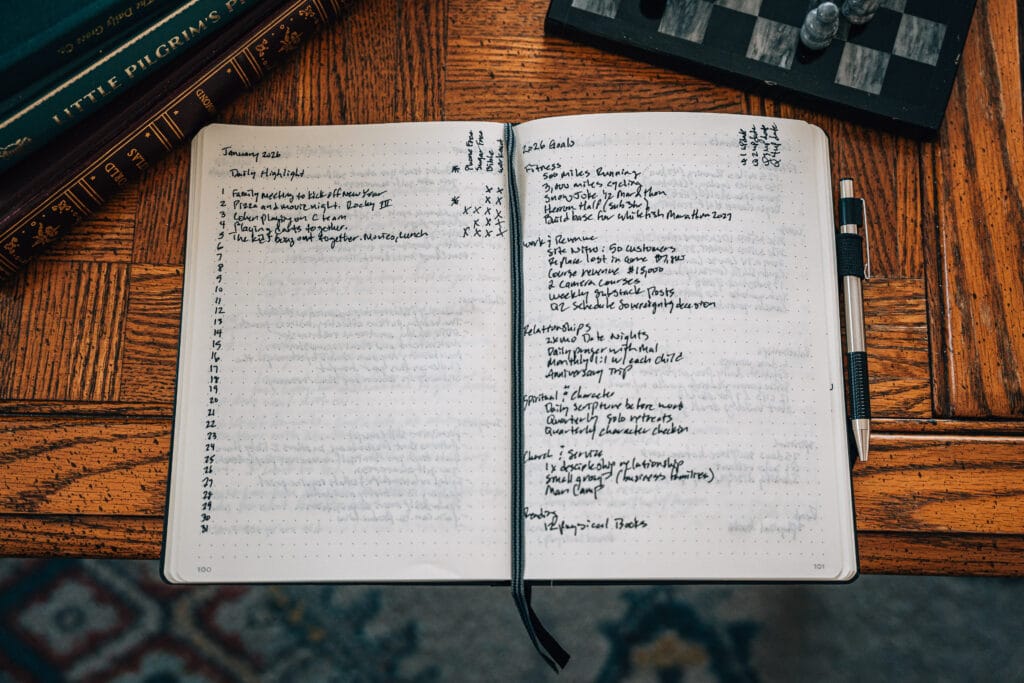
My 2026 Goals
Here’s what I’m working toward this year, organized by priority:
Work & Revenue (Primary Focus: Site Nitro)
Everything else I do either supports Site Nitro or runs parallel to it. This is the business with the highest leverage, and it deserves my primary attention.
- Site Nitro: 50 customers by December 31 (10 by Q1, 25 by Q2)
- Site Nitro content: 10 blog posts + 5 YouTube videos in Q1 (WordPress pain points my ideal customers are searching for)
- Replace lost client income ($7,800) by June 30
- Course revenue: $15,000 (up from ~$10K in 2025)
- Create 2 camera courses (for the new models I already have in hand)
- Weekly Substack (52+ posts)
- YouTube videos sponsor Site Nitro (my own channels promoting my own service)
The insight that unlocked this: my tech and camera channels aren’t distractions from my “real” business. They’re the top of the funnel. They drive course sales. And now they can drive awareness of Site Nitro too.
For years, I’ve been afraid that mentioning my courses in videos would make them feel like sales pitches. Here’s the reframe: I can create videos that provide tremendous value on their own AND mention that I have a course for people who want a more structured, step-by-step approach. That’s not being salesy. That’s serving people at different levels of commitment.
Fitness
- 500 miles running (~42 miles/month)
- 3,000 miles cycling (maintaining my 2025 level)
- Snow Joke Half Marathon (February)
- Herron Half Trail Run under 3 hours (June — I finished last in 2023 and I want to conquer this race)
- Build marathon base for 2027 Whitefish Marathon (I finished last in 2024 at 6 hours; I want to run it again at 4 hours)
Running has become essential to my mental health. When I run consistently, I have more mental bandwidth. I make better decisions. I’m less susceptible to the cheap dopamine hits that derail my focus — the mindless scrolling, the unnecessary snacking, the escaping into content consumption.
I started running at 40 after telling myself for my entire adult life that I wasn’t built to run. That story was a lie. My knees have never been stronger.
Relationships
- Twice-monthly date nights with my wife (24+ planned dates)
- Daily prayer together
- Monthly one-on-one time with each of my four kids (48 individual connections)
- Anniversary trip in April (18 years)
- Initiate a small group with other business-owner families (Q1-Q2)
I’ve acknowledged something hard this year: I’ve allowed differences between my wife and me to create distance. I’ve been passive when I should have been present. I’ve been dismissive when I should have been curious.
The communication goal we’re working on together: sharing how we feel in the moment rather than letting things collect until one of us blows up out of frustration. This isn’t a metric I can track in a spreadsheet. But it’s one of the most important goals I have.
Spiritual & Character
- Daily Scripture before work (300+ days)
- Quarterly solo retreats (technology-free time for reflection, planning, and prayer)
- Quarterly character check-ins with trusted men
- One discipleship/mentoring relationship
I’m stepping back from my role as a deacon at my church this year. There are leadership issues I can’t resolve, and I’ve realized I want to serve in more relational ways rather than positional ones. I’ll still play drums on the worship team occasionally and help with the livestream, but I’m not committing to new roles unless there’s significant change.
What I am committing to: finding one person to walk alongside in a discipleship relationship. And joining or forming a small group with other families where I can relate to and grow with the men.
Reading
- 12 physical books (1 per month)
I completed 8 physical books and 16 audiobooks in 2025. This year, I want to be more intentional about finishing what I start. One book per month, read physically, is the goal.
The System: How My Journal Holds It All Together
Goals are worthless without a system to pursue them. For me, that system is my journal.
I write in a Leuchtturm Medium A5 dotted notebook. Every day, one page. No apps. No digital tools. Just pen and paper.
This is intentional. My work is almost entirely digital. I spend hours every day staring at screens. The journal is a counterbalance — something tactile and slow that forces me to think differently than I do when I’m typing.
Here’s how the system works:

Daily Page
Every day, I write one page that includes:
Top 3-5 tasks. Not everything I could do. The things that matter most today.
My schedule. What’s actually on the calendar. This helps me see where my time is going.
My workout. What I did, how it felt. Tracking this keeps fitness visible and accountable.
Reflections. This is the heart of the page. I might write about:
- A quote from something I read that stuck with me
- Something a friend said during coffee that I want to remember
- An interaction with one of my kids I don’t want to forget
- How I was feeling and what led to any focus or distraction I faced
The reflection piece is where I process my life. Writing helps me metabolize what’s happening — to understand it rather than just experience it. When I skip journaling, I feel disconnected from my own days.
Monthly Tracking Page
At the start of each month, I create a page with daily tracking rows:
- One good thing that happened today (a single line forcing gratitude)
- Did I work out? (yes/no)
- Did I consume added sugar? (my family is cutting this out in January)
- Other habits I’m tracking (Scripture before work, etc.)
This page gives me a visual snapshot of the month. At a glance, I can see patterns — strings of good days, stretches where I fell off, correlations between habits.
Weekly Recap (Sundays)
At the end of each week (my week runs Sunday-Saturday), I complete a weekly recap page:
Wins. What went well this week? (3-5 bullets)
Challenges. What was hard? (2-3 bullets)
Goal Check-In. A quick pulse on each goal area:
- Fitness: ✓ / ✗ / —
- Work: ✓ / ✗ / —
- Relationships: ✓ / ✗ / —
- Spiritual: ✓ / ✗ / —
- Reading: ✓ / ✗ / —
(✓ = on pace, ✗ = behind, — = not applicable this week)
One Pattern. What did I notice about myself this week? This is where self-awareness happens. Maybe I noticed I procrastinated every time I needed to work on a specific project. Maybe I realized I was more patient with my kids on days I worked out. The pattern might be positive or negative — the point is to see it.
One Adjustment. Based on the pattern or goal check-in, what will I do differently next week? This closes the loop. Awareness without action is just navel-gazing.
Next Week’s Focus. One primary focus that moves my goals forward. Not a task list — a priority. If everything else falls apart but I do this one thing, the week is a win.
Monthly Roll-Up (Last Day of Each Month)
At the end of each month, I complete a monthly roll-up page that aggregates the weekly recaps:
Wins. Top 3 wins for the month.
Challenges. Top 2 challenges.
Goal Metrics. A table with target vs. actual:
Goal Target Actual Running miles 42 ___ Cycling miles 250 ___ Site Nitro customers 3-4 ___ Course revenue $1,250 ___ Substack posts 4-5 ___ Date nights 2 ___ One-on-ones (kids) 4 ___ Scripture before work 25 ___ Books finished 1 ___
One Pattern. What did I notice about myself this month?
One Adjustment. What will I do differently next month?
Next Month’s Focus. One primary focus.
This monthly view prevents me from arriving at a quarterly review surprised by my results. The numbers don’t lie. If I’m behind, I know it in real-time.
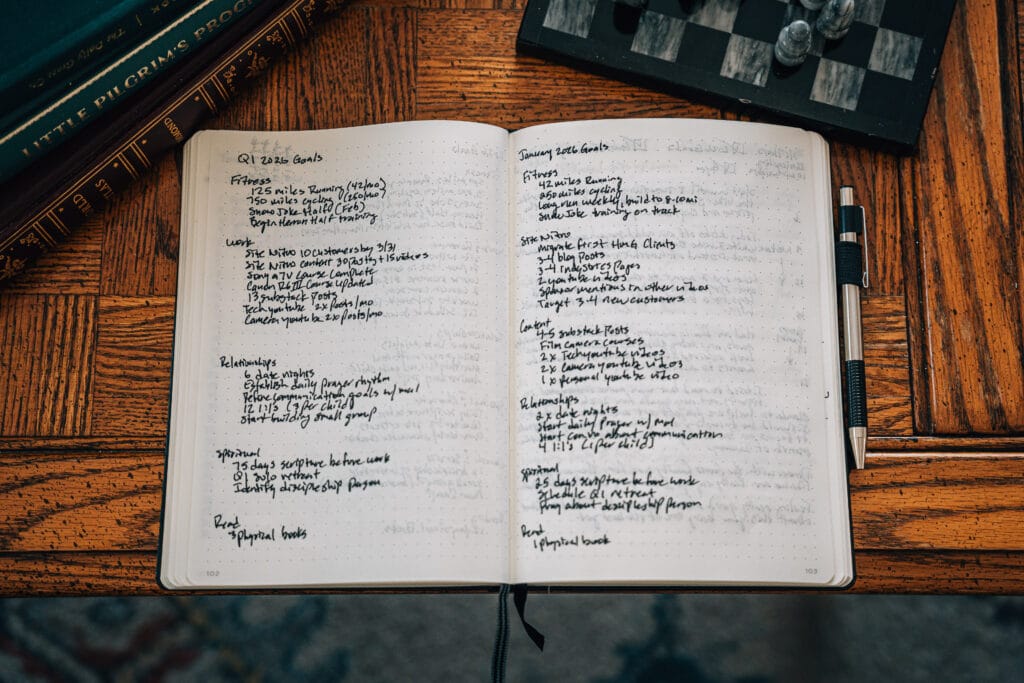
Quarterly Retreat
Four times a year, I take a solo retreat — typically a day or two away with no technology except what I need for travel. Just my journal, my Bible, and whatever book I’m reading.
This is where I zoom out. I review my goals, assess my trajectory, and make bigger adjustments. I pray about what’s working and what’s not. I process things that are too big for a weekly recap.
The quarterly retreat is also where I evaluate decision points. By Q2, I’ll use this time to decide what to do with Schedule Sovereignty. By Q3, I’ll evaluate my overall content strategy.
Why Analog?
People ask me why I don’t use an app for this. I review phones for a living. I’ve owned hundreds of them. I know what technology can do.
But I also know what it does to me.
When I’m on a screen, part of my brain is always scanning for the next thing. The next notification. The next tab. The next dopamine hit. Digital tools are designed to keep us engaged, which means they’re designed to keep us distracted.
The journal slows me down. There’s no algorithm suggesting what I should write about next. There’s no notification pulling me away mid-sentence. There’s just the page and my thoughts.
Writing by hand also forces me to be more intentional. I can’t write as fast as I type, so I have to choose my words more carefully. I can’t copy and paste, so I have to synthesize rather than accumulate.
The journal is a daily act of resistance against the pull of modern technology. It’s one of the best things I do for my mental clarity and focus.
What I’m NOT Doing
This system might sound comprehensive, but what makes it work is what I’ve left out.
I’m not tracking everything. I track the metrics that matter for my specific goals. I don’t track water intake, screen time, or dozens of other things I could measure. More tracking isn’t better. Focused tracking is better.
I’m not using complex systems. No color-coded categories. No elaborate spreads. One page per day, one page per week, one page per month. Simple enough that I’ll actually do it.
I’m not setting goals where I don’t have clarity. Schedule Sovereignty could become a course, a book, a podcast, or nothing at all. I’m not forcing a decision. I’m writing, observing what resonates, and I’ll decide by Q2.
I’m not chasing monetary goals without a plan. I’d love to make $100,000 more this year. But that number doesn’t give me direction. It would have me chasing every shiny opportunity trying to find the most promising one. Instead, I’ve set specific targets tied to specific actions: 50 Site Nitro customers, publish new courses, a few new client projects. If I hit those targets, the money follows.
I’m not abandoning what’s working to chase what’s new. This is the hardest one for me. New ideas are intoxicating. But I’ve learned that the grass isn’t greener — it’s greener where you water it. I’m watering what I’ve already planted.
Building in Public
One more piece of accountability: I’m building in public.
In December, I was sharing daily updates about Site Nitro. In 2026, I’ll be posting weekly recaps to social media and occasionally writing longer updates here when I have insights worth sharing.
This isn’t about performance. It’s about accountability. When I know other people are watching, I show up differently. The public commitment creates pressure that helps me follow through.
If you’ve been following along with my Site Nitro journey or my writing here, you’re part of that accountability. Thank you.
The Invitation
I’m not sharing this because I have it all figured out. I’m sharing it because I’ve spent too many years being busy without being purposeful.
2025 taught me that diversification protects you from catastrophe but doesn’t guarantee growth. You can have multiple income streams and still feel scattered. You can work hard and still miss your goals.
What’s different about 2026 is clarity. I know what the main thing is Site Nitro. I know how everything else supports it or runs parallel. I know how to check in weekly and monthly so I don’t arrive at December surprised.
And I have a journal that holds it all together.
If you’ve been thinking about journaling — or if you journal but feel like you’re just going through the motions — here’s my encouragement: start simple. One page a day. Your top tasks, your schedule, your workout, and a few sentences about how you’re feeling.
That’s it. Don’t overcomplicate it.
The magic isn’t in the system. The magic is in the daily practice of paying attention to your own life. Of noticing patterns. Of asking yourself whether you’re moving toward what matters or just staying busy.
The journal won’t make you more productive. But it will make you more aware. And awareness is where change begins.
What’s your system for staying focused on what matters? I’d love to hear what’s working for you. Reply to this leaving a comment below.